MetricFlow
The harness wrote the code. Here's what worked and what didn't.
A Phoenix LiveView marketing analytics platform built by CodeMySpec in 13 working days. OAuth integrations across five platforms, multi-tenant accounts with agency white-labeling, correlation analysis, AI insights. If the app holds up, the tool that built it holds up. Here's both sides.
What is MetricFlow?
MetricFlow is a Phoenix LiveView marketing analytics platform that correlates advertising spend across Google Ads, Facebook Ads, and Google Analytics with revenue data from QuickBooks. It offers multi-tenant accounts with role-based access, OAuth integrations for five platforms, correlation analysis with AI-powered insights, interactive Vega-Lite dashboards, and an AI chat interface for data exploration.
Google Analytics
Website traffic, user behavior, and conversion tracking
Google Ads
Advertising spend, campaign performance, and ROI tracking
Google Search Console
Search performance, indexing status, and keyword rankings
QuickBooks
Revenue, expenses, daily credit/debit breakdowns
Facebook Ads
Ad performance, reach, and campaign ROI
Key Features
- Correlation analysis engine: raw and SmartAI modes with goal configuration
- Interactive Vega-Lite dashboards with date range controls and platform filters
- Multi-tenant accounts with agency white-labeling and client management
- Automated daily data sync with Oban job processing
- LLM-generated custom reports from natural language prompts
- AI chat interface for data exploration
- Full BDD specification framework with automated QA
User Stories
The stories that drove MetricFlow's development, from user registration through correlation analysis and AI chat. Every feature started as a story with testable acceptance criteria.
Open Source Repository
MetricFlow is fully open source. Browse the code, check the commit history, and see the methodology in action.
View on GitHubThe Dev Story
The Good, The Bad, and The Ugly
An honest assessment of building a full-stack Phoenix app with CodeMySpec. The calendar span is January 30 to March 20, 2026, but the actual work happened across just 13 working days. What we learned changed how the entire pipeline works.
The Velocity Was Real
The first commit landed on January 30: a Phoenix scaffold. Two days later, a 48-hour sprint laid down the entire foundation: Oban, Vault, PromEx, the BDD framework, and 25,000+ lines of specifications before a single line of business logic existed. By end of February, the core domain was complete: Accounts, Integrations, Metrics, DataSync with four providers, ~22,000 lines of unit tests, and 50+ BDD spex files.
The Architecture Held Up
Boundary-enforced module dependencies, context modules as the public API surface, %Scope{} threaded through every public function, repository pattern separating queries from business logic. The factory understood Phoenix conventions and produced idiomatic Elixir. The invitation system came with the full lifecycle (send, accept, cancel, role assignment, token invalidation) with appropriate authorization checks.
The Dashboard Came Out Clean
The dashboard redesign is a good example of what the factory can do when the spec is clear. It generated a multi-series Vega-Lite chart with date range controls, platform filters, data tables, and proper Phoenix hooks for CSP-safe rendering. The QueryBuilder that feeds it was clean, tested, and worked on the first deploy.
QA Infrastructure Was the Best Output
Over the final two weeks, automated Vibium browser agents ran QA scenarios against 25+ stories, producing hundreds of screenshots and structured pass/fail reports. The QA agents found real bugs (nil account guards, broken token invalidation, missing navigation links, role select defaults) and the coding agents fixed them in the same commit cycle.
Agency-to-Account Link Was Broken
The white-label and agency features were structurally present but not wired together. The last two commits, written with heavy human guidance, finally connected agency accounts to client accounts and got auto-enrollment working. The factory had generated the Agencies context, the repository, and the WhiteLabelHook, but never connected them to the account settings UI.
QuickBooks Data Sync Was Wrong
The original QuickBooks provider fetched data in a format that didn't match how the correlation engine consumed it. An 8,000-line rewrite switched from aggregate fetches to daily credit/debit breakdowns. The factory's first attempt produced code that technically synced data but produced unusable correlation results. The cassette fixtures alone went from 352 to 7,708 lines.
Visualizations Were Anemic
The ReportGenerator generates Vega-Lite specs from natural language via LLM, but the generated reports are generic and not anchored to the user's actual data. You can't refine them by conversation. The saved visualizations had no useful index page; QA needed four failed attempts before the route even existed. The feature technically works but wouldn't survive contact with a real user.
AI Chat Lacked Real Data Access
The chat interface renders, accepts messages, saves history, and can call the LLM, but the context injection for metrics, correlations, and dashboards is stubbed. The QA agent marked it as passing because it could send and receive messages. The responses just aren't grounded in anything useful.
Too Many Pipeline Steps, Not Enough Signal
The full pipeline ran BDD specs, then component specs, then design review, then unit tests, then implementation, then QA. Most of that middle layer added time without catching problems. The component specs and design reviews rarely surfaced issues that the BDD scenarios and QA runs didn't already cover. The pipeline was doing six things when three of them actually mattered.
Integrations Were a Nightmare
The integration code went through more QA iterations than every other feature combined. Connecting marketing platforms via OAuth had six failed QA runs before passing. Managing integrations had seven. Triggering data sync had twelve failed runs across two days. The problem was compounding failures: when the agent fights both broken integration code AND invalid OAuth tokens simultaneously, it papers over everything.
Agents Built a Potemkin Village
The coding agent would catch a FunctionClauseError, wrap it in try/catch, show a flash message saying "connection successful," and move on. The QA agent would see the flash message and mark the scenario as passing. Both agents were collaborating to produce a Potemkin village of passing tests over broken functionality. The QA agent told me over and over that QA passed, and I'd go click through the integrations and find nothing actually worked.
Google Provider Architecture Was Wrong
The factory initially generated a single "Google" provider for Ads, Analytics, and Search Console through one OAuth flow. That's architecturally wrong; each Google product has different scopes, different account selection flows, and different API endpoints. A massive refactor to split them into separate providers had to be guided step by step. The factory couldn't reach this decision on its own because the spec said "connect Google" and it connected Google.
Ambiguity Compounded Through Every Layer
A vague story produced a vague BDD spec. The vague spec produced vague step definitions. The vague steps produced code that technically satisfied the spec but didn't do what anyone actually wanted. By the time QA caught the problem, the fix meant rewriting everything back to the story. There was no gate between the story and the spec where a human could say "wait, what do we actually mean by this?" That missing gate was the root cause of most of what went wrong.
Manual Debugging Was Unavoidable
I eventually sat down for two days and QA'd the integrations with the agent by hand, pointing at each broken flow and walking it through the fix. That was the only way to get working integrations. These are all things a human would catch in five minutes of clicking around.
how it looks
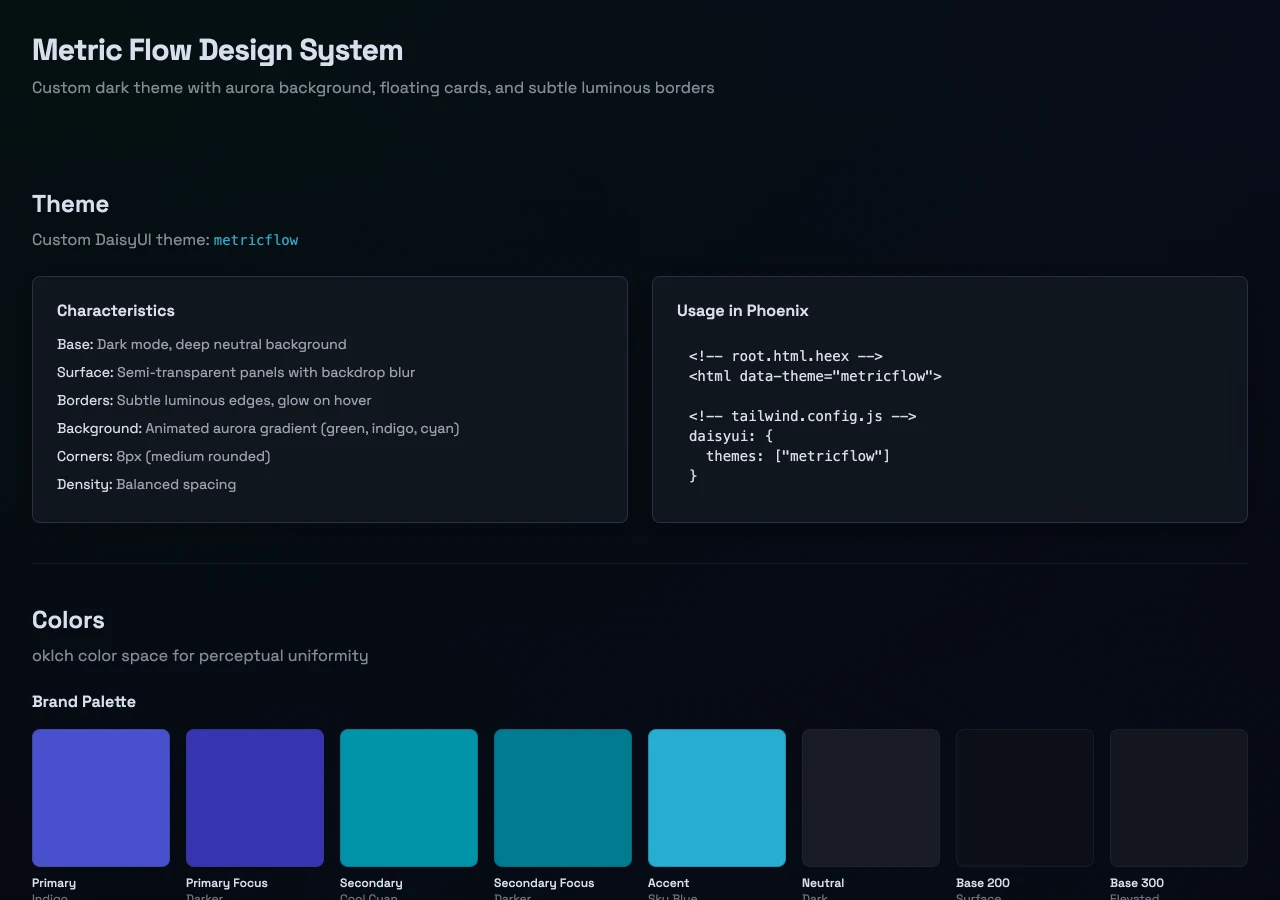
A dark theme that had to feel alive.
MetricFlow's look was decided once, up front, through a five-question interview rather than page by page. It went custom rather than picking a named theme: a bespoke palette in oklch, indigo and cyan against a deep neutral ground, semi-transparent panels with backdrop blur, and an animated aurora gradient behind the content. A dashboard someone stares at for an hour needs depth cues and needs the numbers to sit forward.
What We Changed After MetricFlow
The Pipeline Had Too Many Steps
MetricFlow ran the full six-phase pipeline: BDD specs, component specs, design review, unit tests, implementation, QA. Most of those intermediate steps added ceremony without catching real problems. The specs that mattered were the BDD scenarios at the top and the QA runs at the bottom. Everything in between was overhead that slowed the factory down without making the output better.
The Core Loop is Three Steps
After MetricFlow, we stripped the pipeline to what actually works: BDD specs, code, QA. That's it. Write the scenarios that define what "done" looks like, let the machine build it, then verify it works in the running application. Component specs, design reviews, and unit tests are still available for teams that want them, but they're optional. The default path is the shortest one that ships working software.
Stories Were Flowing Into Specs Unexamined
The biggest problem wasn't the code generation. It was that ambiguous stories were flowing straight into BDD specs with no human gate. The spec inherited every vague assumption from the story, the step definitions inherited it from the spec, and the implementation inherited it from the steps. Ambiguity compounded through three layers. By the time QA caught a problem, the fix meant rewriting everything back to the story.
Example Mapping is the Missing Step
The fix is a structured discovery conversation between the story and the spec. It's called Example Mapping (from Matt Wynne and the Cucumber team): take a story, extract the business rules, walk through concrete examples, surface open questions, and produce scenario titles. Those titles become your acceptance criteria and your BDD scenarios. One artifact, not two. Then the human reviews the feature file before codegen starts. That single gate prevents most of what went wrong in MetricFlow.
13 working days. 51 stories. 434 acceptance criteria. MetricFlow proved the harness works — and proved where it broke. The fix wasn't more automation. It was less pipeline and one better gate. Example Mapping into BDD specs, code, QA. Three steps. One human review. That's the loop that ships.